What it is
While vite dev runs, the plugin serves an MCP endpoint at /__svelte-devtools/mcp (Streamable HTTP). Agents usually reach it through vite-devtools-svelte mcp, a small stdio server that forwards each call, and
call tools to read what the panels show: the busiest components, the reactive graph of one
instance, sampled state changes, render profiles, load functions and frame rate. They can
also run measurement sessions to compare before and after a change.
No tool changes your app's code or state. Two things do happen: a call keeps the runtime
in the page sampling for about a minute, and the session tools keep measurement sessions
(in memory; on disk only when asked, and delete_session removes them). Runtime data comes from the app page open in a browser,
so keep the app open while the agent works.
Connect Claude Code
Register the MCP server once per project. The dev server also prints this command when it starts:
claude mcp add svelte-devtools -- npx @sveltejs/vite-devtools-svelte mcpvite-devtools-svelte mcp runs over stdio and forwards each call to the running
dev server of the project in the current directory. It finds that dev server, its port and its
token by itself, so restarts and port changes need nothing. Without a running dev server, the
tools answer how to start one.
Running dev servers announce themselves in ~/.cache/vite-devtools-svelte/servers/, one file each ($XDG_CACHE_HOME when set, %LOCALAPPDATA% on Windows). Only dev servers on the same machine are
used.
Svelte documentation and code checks
The documentation and svelte-autofixer come from the official Svelte MCP server. This server tells the agent
to use it when it is configured, so add it too:
claude mcp add svelte -- npx -y @sveltejs/mcpProject file instead of the command
claude mcp add registers the server for you only (local scope). A .mcp.json file in the project is shared with everyone who opens the project (project
scope). It holds no token, so it can be committed:
{
  "mcpServers": {
    "svelte-devtools": {
      "command": "npx",
      "args": ["@sveltejs/vite-devtools-svelte", "mcp"]
    }
  }
}
Several dev servers
The stdio server uses the dev server whose root contains the current directory (the
innermost one), or else the only dev server inside it. From a monorepo root, or with the
same app started twice, more than one can match. The agent then calls list_dev_servers and passes server with the one to use: its id, its
root or its package name.
Ask
For example, with the cart page of your app open:
The cart total on /cart looks wrong after I change the tax rate.
Use the svelte-devtools MCP server: find the busiest components, look at the
ReactivePriceChart instance, and tell me which state can affect grandTotal
and what changed when I edited the tax rate.
The agent typically starts with get_reactive_summary or list_performance_issues and follows the hints in the answers. The walkthrough shows each step with real answers.
Other MCP clients
Clients that start stdio servers use the same command: npx @sveltejs/vite-devtools-svelte mcp. Clients that support only Streamable
HTTP with custom headers connect to the dev server directly. They need two values:
- URL:
http://localhost:<port>/__svelte-devtools/mcp - Header:
x-svelte-devtools-token: <token>
The token changes on every start of the dev server; see where to get the token. The HTTP endpoint is stateless and answers with JSON. To check it by hand:
curl -s http://localhost:5173/__svelte-devtools/mcp \
  -H 'content-type: application/json' \
  -H 'accept: application/json, text/event-stream' \
  -H 'x-svelte-devtools-token: <token>' \
  -d '{"jsonrpc":"2.0","id":1,"method":"tools/list","params":{}}'
Containers, other machines and middleware mode
The stdio server finds only dev servers on its own machine that announced themselves. A dev server in a container or on another machine is not found, and in Vite middleware mode the plugin has no server of its own to announce. Then give the stdio server the endpoint yourself:
VITE_DEVTOOLS_SVELTE_URL: the dev server as the MCP client reaches it, such ashttp://localhost:5173. Without a path,/__svelte-devtools/mcpis added.VITE_DEVTOOLS_SVELTE_TOKEN: the token of that dev server. Required with the URL.
With these set, every call goes to that endpoint and server is ignored. For Claude
Code:
claude mcp add svelte-devtools \
  -e VITE_DEVTOOLS_SVELTE_URL=http://localhost:5173 \
  -e VITE_DEVTOOLS_SVELTE_TOKEN=<token> \
  -- npx @sveltejs/vite-devtools-svelte mcp
The token changes on every start, so update the registration after the dev server restarts.
Where to get the token
- From the dev server's file in
~/.cache/vite-devtools-svelte/servers/on the machine or in the container where it runs: the file is named<pid>-<port>.jsonand holdstokenandurl. - In middleware mode no file is written. Read the token from the API of the plugin named
vite-devtools-svelte(asexamples/svelte-middleware/server.jsin the repository does):
const vite = await createServer({ server: { middlewareMode: true } });
const devtools = vite.config.plugins.find(p => p.name === 'vite-devtools-svelte');
const token = devtools?.api?.getDevtoolsToken?.();The 20 tools
All inputs are optional unless they have no ?.
The dev server endpoint has these 20 tools. vite-devtools-svelte mcp adds list_dev_servers and a server? input to each of them; see the last group.
Reactivity (bounded)
New in 0.4.0. Each answer says what it covers: coverage, sampling, caps, page load (epoch) and whether it is stale. Start here in large apps.
get_reactive_summarytopK?: 1–200
The busiest live component instances from runtime counters over all instances, without capturing the graph: sampled state changes and renders since each instance mounted and when it was last active, `rows` + `other` adding up to the totals.
Counts are totals (at most one change per state per 200 ms), not rates; a destroyed instance leaves with its counts. State changes are sampled only while a panel or an agent is watching. State created during component init and shared .svelte.js/.ts module state are tracked; module scopes are rows with kind "module", and their componentId works with get_reactive_scope. Answered from a cache for up to 1 s.
get_reactive_scopecomponentId?: number, epoch?: string, maxNodes?: 1–5000, maxEdges?: 1–20000
$state / $derived / $effect nodes of one component instance and their direct neighbours. Without componentId: the whole-app graph, capped.
componentId requires the epoch it came from (get_live_components with includeMeta). After a reload the answer is empty with staleReason "epoch-changed". Edges mean "can affect", not a recorded cause.
get_state_timelinesince?: cursor, limit?: 1–500 (default 100), maxValueChars?: 16–32768 (default 2048)
Sampled $state changes after a cursor, with old and new values. Pass the returned `cursor` as `since` on the next call.
`reset: true` means the cursor was stale and this is the whole buffer (the latest 500). Larger values are replaced by a size summary. Timestamps are detection times.
get_capture_info—
Per dataset: how many items the DevTools hold versus what the app reported, the selection policy, and dropped counts by reason.
Read this before drawing conclusions from capped data.
Performance issues
Ranked findings across render, reactivity, load functions and frame rate.
list_performance_issuesavgRenderTimeMs?, renderCount?, loadDurationMs?, fpsDropThreshold?, effectMaxDeps? (thresholds)
Cross-cuts all metrics and returns ranked issues. Each issue names the tool to call next in `suggestedTool`.
Reads the whole-app reactive graph, capped at 5000 nodes / 20000 edges.
get_component_hotspotstopN?: 1–200 (default 20)
Top components by total render time, with render count and average per render.
get_render_profilefile: string (substring)
Render profile entries of the components whose file contains `file`.
get_reactive_graph_problemseffectMaxDeps?: number
Over-connected effects, orphan deriveds (never evaluated so far) and isolated nodes (no tracked dependency or reader; reads from the markup count), as categories instead of the full graph.
Reads the whole-app reactive graph, capped at 5000 nodes / 20000 edges.
get_load_waterfallroute?: string
SvelteKit load profiles grouped by route, with timing and data size.
get_fps_dropsthreshold?: 1–120 (default 40), sinceMs?: number
Frame-rate samples below the threshold.
Project context
What the app is made of, from static analysis and the running page.
get_project_info—
Package name and version, Svelte / SvelteKit / Vite versions, dependency lists.
get_routes—
The SvelteKit routes tree from static analysis.
get_live_componentsincludeMeta?: boolean, limit?: 1–50000
Component instances mounted in the browser, parents first. With includeMeta: `{ epoch, total, captured, truncated, components }`, limited to 1000 by default.
Component ids are only valid within that epoch (one page load).
get_component_relations—
Static import relations between .svelte components.
Measurement sessions
Measure before and after a change, then compare.
start_sessionlabel: string, persist?: boolean
Begin capturing metrics under a label. One session is active at a time.
end_sessionkeep?: "memory" | "disk" | "discard" (default "memory")
Close the active session and return its delta.
"disk" writes to node_modules/.vite-devtools-svelte/sessions/ in the project.
compare_sessionsa: session id, b: session id
Diff render, load and frame-rate metrics of two ended sessions. Each section has a verdict: improved, regressed or unchanged.
list_sessions—
Sessions in memory and on disk, most recent first.
load_sessionid: session id
The full session record, including its delta once ended.
delete_sessionid: session id
Remove a session from memory and disk.
Dev servers (stdio only)
Added by vite-devtools-svelte mcp. Every tool above also takes server?: id from list_dev_servers, root or package name, needed only when more than one dev server
matches.
list_dev_servers—
Dev servers running with the plugin on this machine (id, package name, root, URL, start time), and which one the other tools use when `server` is omitted.
With VITE_DEVTOOLS_SVELTE_URL set, `override` shows that endpoint and no listed server is the default.
Walkthrough: why did it update?
Real calls against the example app (examples/sample-app, now examples/kit-shop, a synthetic shop) with one item in the cart. Absolute
paths are replaced by <project>; long answers are shortened where marked.
Recorded by scripts/screenshots/mcp-examples.mjs in CI run 37204003993 (linux x64, Node v22.23.3) at commit 533928b (the PR #85 merge ref), with the 0.4.0 code before the version bump (package version 0.3.0 at capture), on examples/sample-app (now examples/kit-shop), a synthetic demo app. Absolute paths are shown as <project> / <repo>, and arrays longer than 4 are cut where marked; no value was changed, except that the get_reactive_summary answer was converted by hand to the current response shape (the time window replaced by computedAt and lastActiveAt, which are illustrative).
Find where the activity is
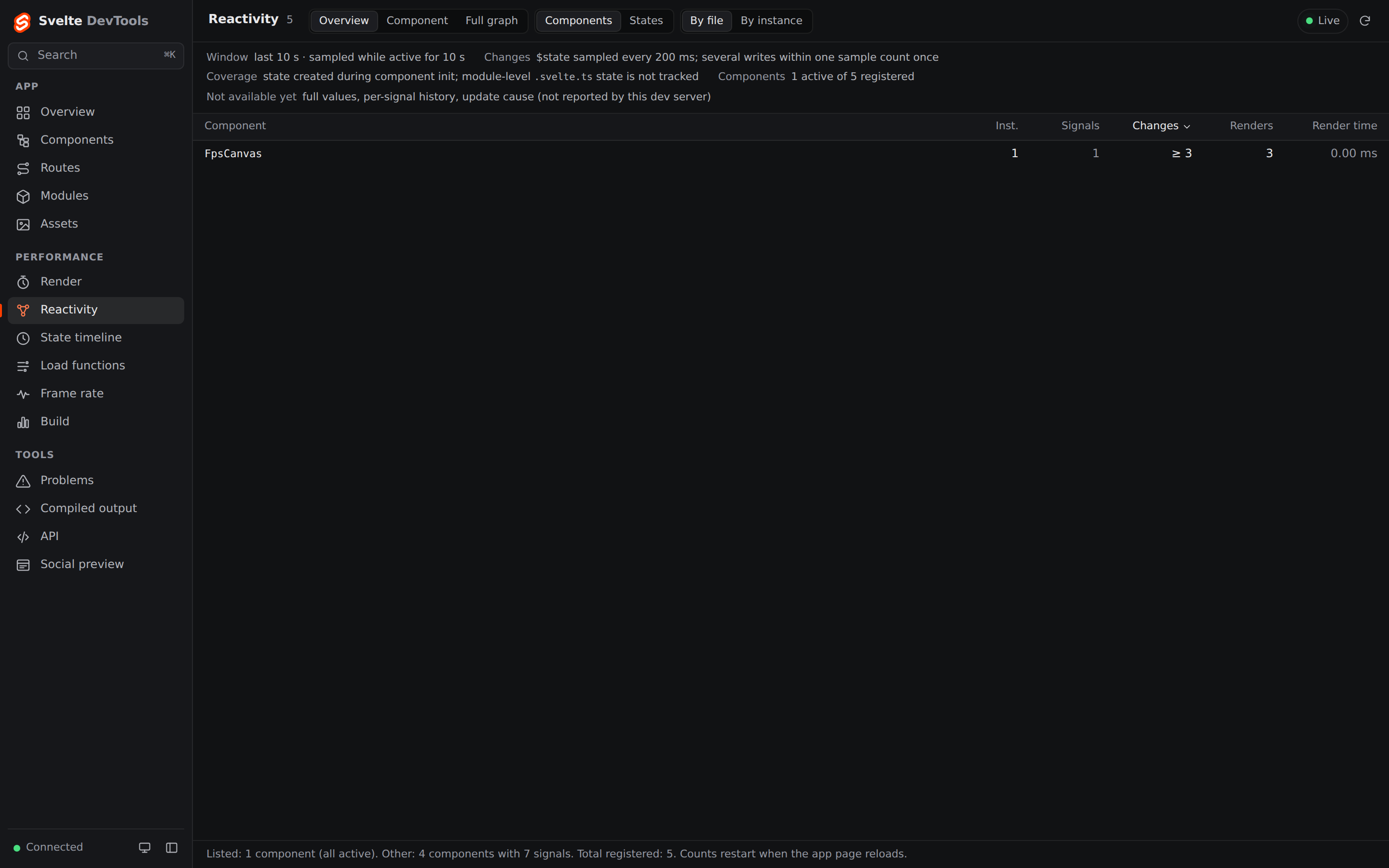
Counters over all live instances, totals since each mounted, without capturing the graph. The answer says what it covers: here 2 of 5 registered components were active, and lastActiveAt says when each last changed or rendered (the runtime samples state only while a panel or an agent is reading). The price chart has not changed yet, so it is not listed.
→ get_reactive_summary json { "name": "get_reactive_summary", "arguments": { "topK": 5 } }← response json { "epoch": "yotxdjn137mutu4dc2", "computedAt": 1791119196841, "policy": "sampled-200ms", "coverage": "component-init", "components": { "total": 5, "withActivity": 2 }, "rows": [ { "componentId": 0, "file": "<project>/.svelte-kit/generated/root.svelte", "nodes": { "state": 3, "derived": 2, "effect": 2 }, "changes": 2, "renders": 1, "renderMs": 0, "lastActiveAt": 1791119195295 }, { "componentId": 2, "file": "<project>/src/lib/components/Header.svelte", "nodes": { "state": 0, "derived": 0, "effect": 0 }, "changes": 0, "renders": 2, "renderMs": 0.1, "lastActiveAt": 1791119195310 } ], "other": { "components": 3, "nodes": 8 }, "truncated": false, "capabilities": { "valueInspection": false, "signalHistory": false, "writeCause": false }, "baseline": { "complete": true, "pendingNodes": 0 } }Get instance ids with their page load
Component ids restart on every page load, so ask for the epoch together with the ids. ReactivePriceChart is instance 14 here.
→ get_live_components json { "name": "get_live_components", "arguments": { "includeMeta": true, "limit": 50 } }← response (shortened) json { "epoch": "yotxdjn137mutu4dc2", "total": 5, "captured": 5, "truncated": false, "components": [ { "id": 0, "file": "<project>/.svelte-kit/generated/root.svelte", "name": "root", "parentId": null, "mounted": true }, { "id": 1, "file": "<project>/src/routes/+layout.svelte", "name": "+layout", "parentId": 0, "mounted": true }, { "id": 2, "file": "<project>/src/lib/components/Header.svelte", "name": "Header", "parentId": 1, "mounted": true }, { "id": 13, "file": "<project>/src/routes/cart/+page.svelte", "name": "+page", "parentId": 1, "mounted": true }, "… 1 more" ] }Look at one instance
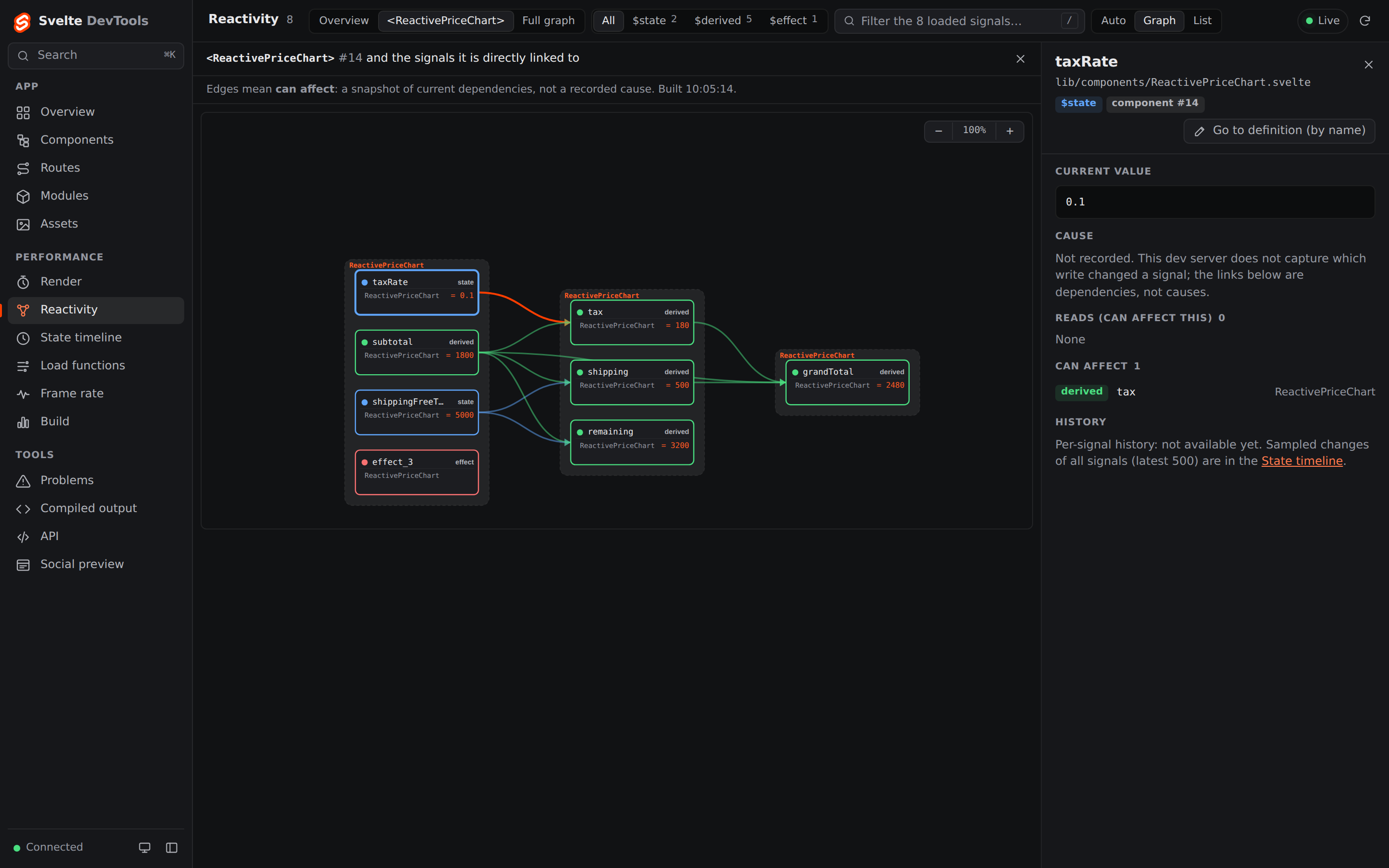
Nodes of that instance and their direct neighbours. An edge means the source can affect the target (a current dependency), not that it caused a change. This answer was recorded with 0.4.0: since 0.5.0 the same call also returns the markup node and the dependencies of the $effect, which has no edges here.
→ get_reactive_scope json { "name": "get_reactive_scope", "arguments": { "componentId": 14, "epoch": "yotxdjn137mutu4dc2" } }← response (shortened) json { "nodes": [ { "id": "14:taxRate", "type": "state", "name": "taxRate", "componentId": 14, "componentFile": "<project>/src/lib/components/ReactivePriceChart.svelte", "value": 0.1 }, { "id": "14:tax", "type": "derived", "name": "tax", "componentId": 14, "componentFile": "<project>/src/lib/components/ReactivePriceChart.svelte", "value": 180 }, { "id": "14:shippingFreeThreshold", "type": "state", "name": "shippingFreeThreshold", "componentId": 14, "componentFile": "<project>/src/lib/components/ReactivePriceChart.svelte", "value": 5000 }, { "id": "14:remaining", "type": "derived", "name": "remaining", "componentId": 14, "componentFile": "<project>/src/lib/components/ReactivePriceChart.svelte", "value": 3200 }, "… 4 more" ], "edges": [ { "from": "14:taxRate", "to": "14:tax" }, { "from": "14:shippingFreeThreshold", "to": "14:remaining" }, { "from": "14:shippingFreeThreshold", "to": "14:shipping" }, { "from": "14:subtotal", "to": "14:remaining" }, "… 5 more" ], "scope": 14, "epoch": "yotxdjn137mutu4dc2", "total": { "nodes": 8, "nodesKind": "registered", "edges": 9 }, "truncated": false, "edgesOmitted": 0, "computedAt": 1791119196854, "policy": "scoped" }Read the change timeline
The first call has no cursor, so reset is true and the answer holds the newest entries of the buffer. Keep the returned cursor. Old and new values are included; larger ones are replaced by a size summary.
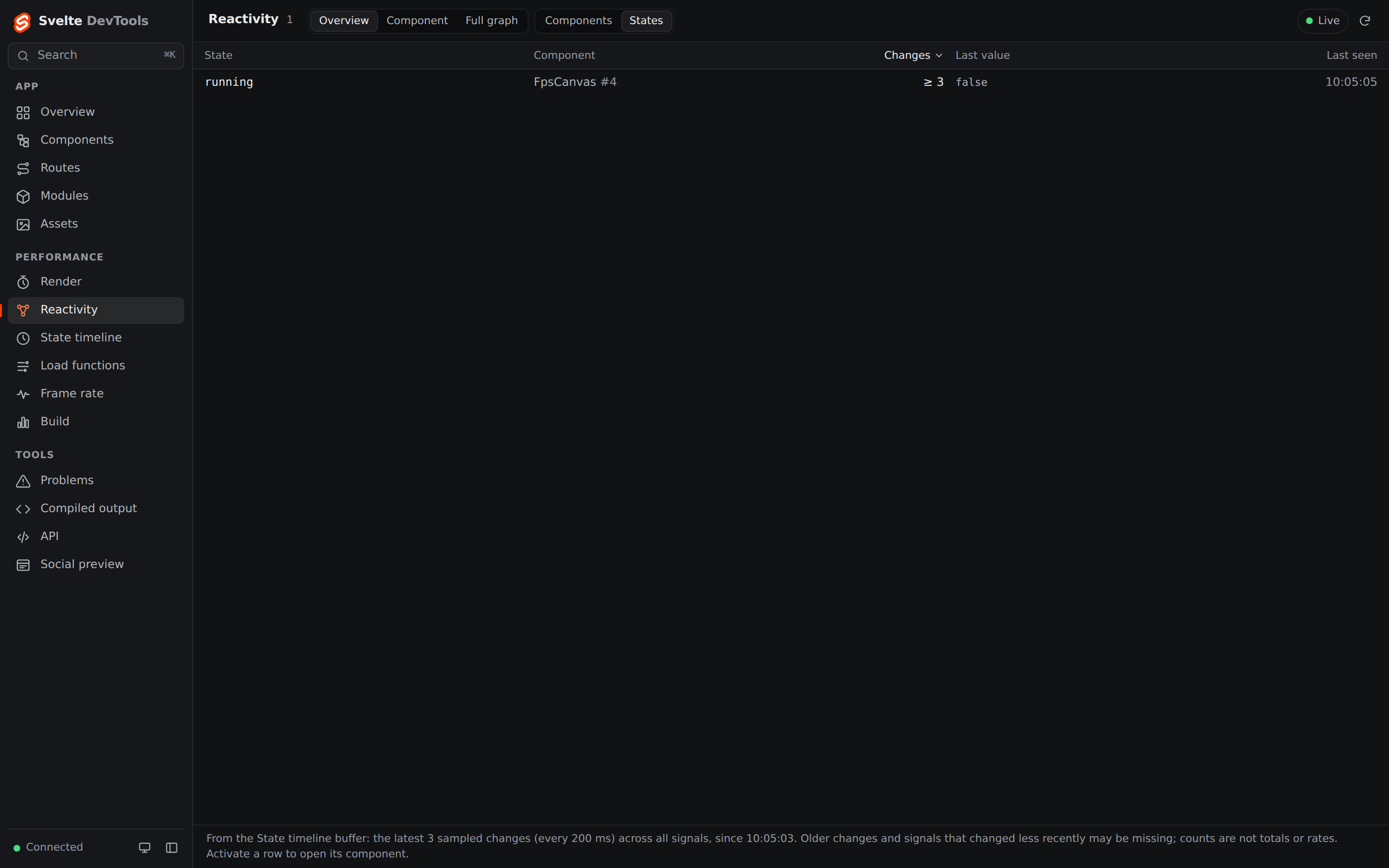
→ get_state_timeline json { "name": "get_state_timeline", "arguments": { "limit": 5 } }← response json { "cursor": 1791119189716031, "reset": true, "changes": [ { "id": "4:running", "name": "running", "componentFile": "<project>/src/lib/components/FpsCanvas.svelte", "oldValue": true, "newValue": false, "timestamp": 1791119192900, "seq": 1791119189716016 }, { "id": "4:running", "name": "running", "componentFile": "<project>/src/lib/components/FpsCanvas.svelte", "oldValue": false, "newValue": true, "timestamp": 1791119194095, "seq": 1791119189716021 }, { "id": "0:navigated", "name": "navigated", "componentFile": "<project>/.svelte-kit/generated/root.svelte", "oldValue": false, "newValue": true, "timestamp": 1791119195295, "seq": 1791119189716030 }, { "id": "0:title", "name": "title", "componentFile": "<project>/.svelte-kit/generated/root.svelte", "oldValue": null, "newValue": "devtools-shop — vite-devtools-svelte sample", "timestamp": 1791119195295, "seq": 1791119189716031 } ], "omitted": 0, "maxValueChars": 2048 }Edit, then read only what is new
After changing the tax rate in the app from 0.1 to 0.08, pass the cursor as since: only that change comes back.
→ get_state_timeline json { "name": "get_state_timeline", "arguments": { "since": 1791119189716031, "limit": 5 } }← response json { "cursor": 1791119189716039, "reset": false, "changes": [ { "id": "14:taxRate", "name": "taxRate", "componentFile": "<project>/src/lib/components/ReactivePriceChart.svelte", "oldValue": 0.1, "newValue": 0.08, "timestamp": 1791119196895, "seq": 1791119189716039 } ], "omitted": 0, "maxValueChars": 2048 }Check how complete the data is
What the DevTools hold versus what the app reported, per dataset, with the selection policy. A total of null means unknown. Read it before drawing conclusions from capped data.
→ get_capture_info json { "name": "get_capture_info", "arguments": {} }← response json { "liveComponents": { "captured": 5, "total": 5, "truncated": false, "policy": "roots-first", "epoch": "yotxdjn137mutu4dc2" }, "renderProfiles": { "captured": 5, "total": 5, "truncated": false, "policy": "newest-mounted", "epoch": "yotxdjn137mutu4dc2" }, "stateTimeline": { "captured": 5, "total": null, "truncated": false, "policy": "sampled-200ms", "baseline": { "complete": true, "pendingNodes": 0 } }, "fpsSamples": { "captured": 12, "total": 12, "truncated": false, "policy": "tail" }, "runtimeErrors": { "captured": 0, "total": 0, "truncated": false, "policy": "tail" }, "loadProfiles": { "captured": 1, "total": 1, "truncated": false, "policy": "tail" }, "compilerWarnings": { "captured": 0, "total": 0, "truncated": false, "policy": "tail" }, "reactiveNodes": { "captured": 8, "total": 8, "truncated": false, "policy": "scoped", "epoch": "yotxdjn137mutu4dc2" }, "reactiveEdges": { "captured": 9, "total": 9, "truncated": false, "policy": "scoped", "epoch": "yotxdjn137mutu4dc2" } }After a reload, ids are refused, not guessed
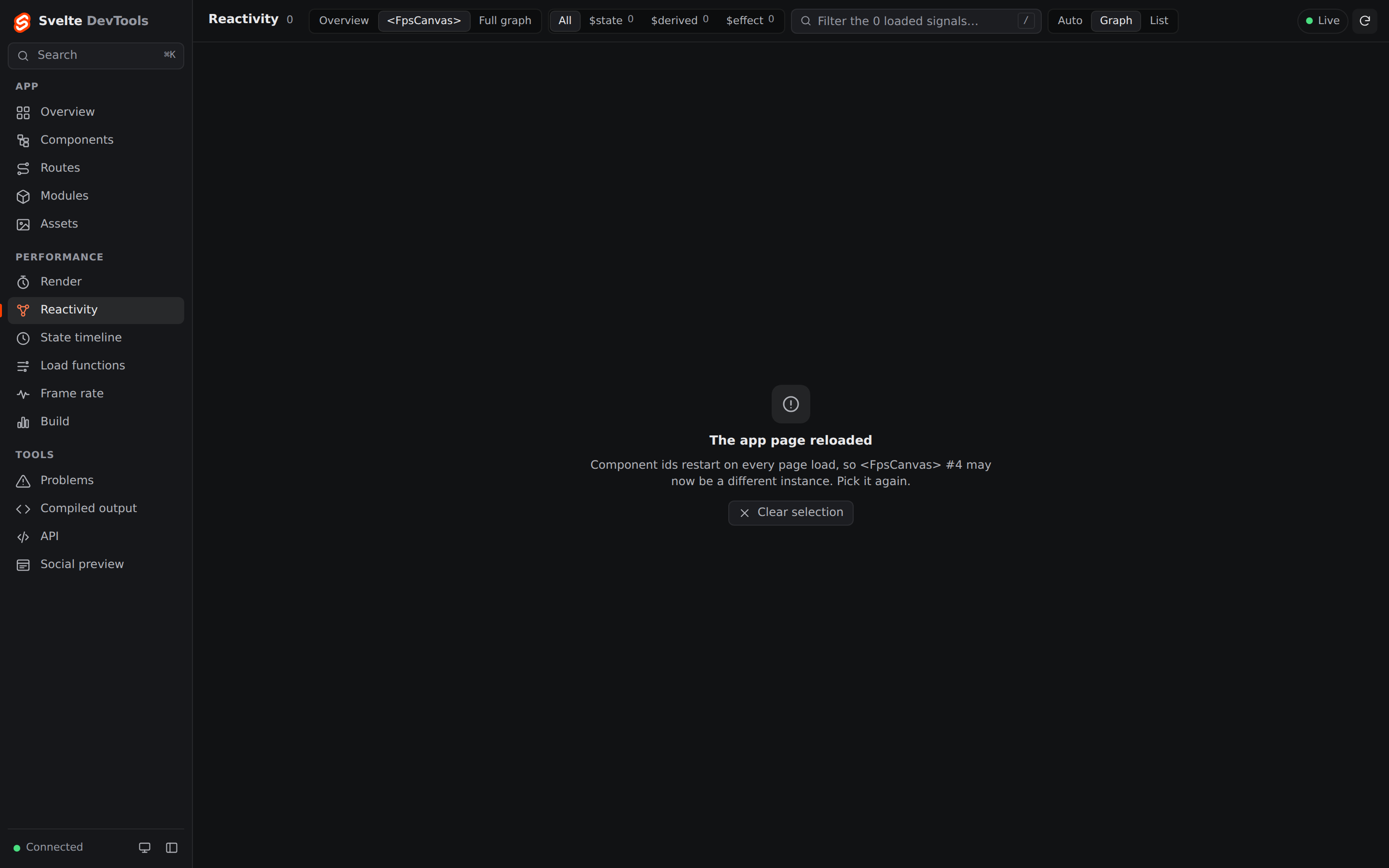
After reloading the app page, the same componentId with the old epoch returns an empty graph with staleReason "epoch-changed" instead of another instance.
→ get_reactive_scope json { "name": "get_reactive_scope", "arguments": { "componentId": 14, "epoch": "yotxdjn137mutu4dc2" } }← response json { "nodes": [], "edges": [], "scope": 14, "epoch": "mv4a1o7rqhmutu4koh", "total": null, "truncated": false, "edgesOmitted": 0, "computedAt": null, "policy": "scoped", "stale": true, "staleReason": "epoch-changed" }
In a large app the same order keeps every answer small: summary first, then one instance, then only the new timeline entries.
Measure a change
Start a session, use the app, end it; do the same after your change, then compare. Each section of the comparison has a verdict. In this run nothing heavy changed between the two sessions, so every verdict is unchanged.
{
  "name": "start_session",
  "arguments": {
    "label": "before"
  }
}{
"id": "s_mutu4ia1_b33526",
"label": "before",
"startedAt": 1791119198089,
"persist": false
}{
"name": "compare_sessions",
"arguments": {
"a": "s_mutu4ia1_b33526",
"b": "s_mutu4jfy_6d6dd6"
}
}{
"a": {
"id": "s_mutu4ia1_b33526",
"label": "before"
},
"b": {
"id": "s_mutu4jfy_6d6dd6",
"label": "after"
},
"render": {
"totalRenderTimeDeltaA": 0,
"totalRenderTimeDeltaB": 0,
"diff": 0,
"verdict": "unchanged"
},
"load": {
"avgA": 0,
"avgB": 0,
"diff": 0,
"verdict": "unchanged"
},
"fps": {
"avgA": 60,
"avgB": 60,
"diff": 0,
"verdict": "unchanged"
}
}Sessions live in memory for the life of the dev server. end_session with keep: "disk" writes them to node_modules/.vite-devtools-svelte/sessions/ in your project.
What the answers cover
- Sampled. State is checked every 200 ms; several writes within one sample count once. Counts are not totals or rates.
- Component and module state. State created during a component's init and
shared state of
.svelte.js/.svelte.tsmodules is tracked. State created elsewhere, such as in an event handler, is not. - Can affect, not caused. Edges are current dependencies. Which write changed a value is not recorded.
- Some dependencies are not shown. Reads of state the DevTools don't
track (created in
node_modules, such as SvelteKit's page state) have no edge; the node counts them inuntrackedDeps. - Values are summaries in the graph. Objects and arrays appear as
(object),[n]or{n}. The timeline includes values up tomaxValueChars. - No per-signal history. The timeline keeps the latest 500 sampled changes across all signals.
- Caps. Graphs stop at 5000 nodes and 20000 edges and say so (
truncated,total,edgesOmitted);get_capture_inforeports what was dropped and why. - One page load. Component ids are valid within one epoch. Answers may
come from a cache for up to 1 s;
computedAtsays when they were computed.
Performance with very large apps has not been measured; no size is promised.
The same data in the panel
The Reactivity panel shows the answers above to people. Screenshots of the real runtime on the example app, taken in CI.
Captured by scripts/screenshots/reactivity.mjs in CI run 37193781813 (Linux,
headless Chromium, 1440×900) on the PR merge commit 623e27a, whose client sources are
those of a42a9e4, on examples/sample-app (now examples/kit-shop,
a synthetic demo app) with the real runtime.
Troubleshooting
403 Forbidden- Over HTTP: the token is missing or from an earlier start. Read it again from the dev
server's file under
~/.cache/vite-devtools-svelte/servers/. No running dev server for …- Start the dev server of the project Claude Code runs in, or pass
serverwith one of the dev servers the answer lists. If the answer says the installed version does not announce its dev server, upgrade it to 0.10.0 or later. For a container, another machine or middleware mode, set the environment variables. The dev server at … did not answer- The dev server stopped, or with
VITE_DEVTOOLS_SVELTE_URLthe URL or the token is wrong. The token changes on every start. VITE_DEVTOOLS_SVELTE_URL is set without VITE_DEVTOOLS_SVELTE_TOKEN- Set both, or neither.
- Empty answers with
staleReason: "no-runtime" - No app page is connected. Open the app in a browser and call again.
staleReason: "timeout"- The app page did not answer within 1 s. The answer is the previous one (with its own
computedAt) or empty; call again. staleReason: "epoch-changed"- The page reloaded. Call
get_live_componentswithincludeMeta: truefor new ids and their epoch. componentId requires epoch- Pass the epoch from the same
get_live_componentsanswer. - No components or reactive nodes
- Check that
componentTrackingis not set tofalseand that the plugin comes beforesveltekit()invite.config.ts. - Several app tabs
- The answers follow the page that reported most recently; close the others.
Security
- The endpoint exists only in the dev server. Production builds don't contain it.
- Every request needs the token. It is random per start and kept in a file only your user
can read (
~/.cache/vite-devtools-svelte/servers/). Treat it like a password and don't commit it. - The token is separate from the browser sign-in of the panels (the one-time code). MCP clients are local processes, so the browser origin is not checked; the token is the gate.
get_state_timelinereturns real state values of your running app, so the agent sees them. Keep secrets out of dev state, or don't use that tool.- When the dev server listens on the network (
--host), so does the endpoint. Prefer localhost. - Sessions are written to disk only with
persistorkeep: "disk", undernode_modules/of the project.
Versions
- vite-devtools-svelte
- ≥ 0.10.0 for
vite-devtools-svelte mcpand this guide; the four reactivity tools came in 0.4.0 - Vite
- ≥ 8.3.5
- Svelte
- ≥ 5.46.4 (runes mode); plain Svelte and SvelteKit 3 are tested in CI
- MCP
- Streamable HTTP, stateless, JSON responses. CI calls the endpoint with plain HTTP (
initialize,tools/list,tools/call).